Choosing a Blade: All-Wood, Inner Carbon, or Outer Carbon, and What Each Does to Your Game
By RallyRove · 10 min read · Updated September 2026
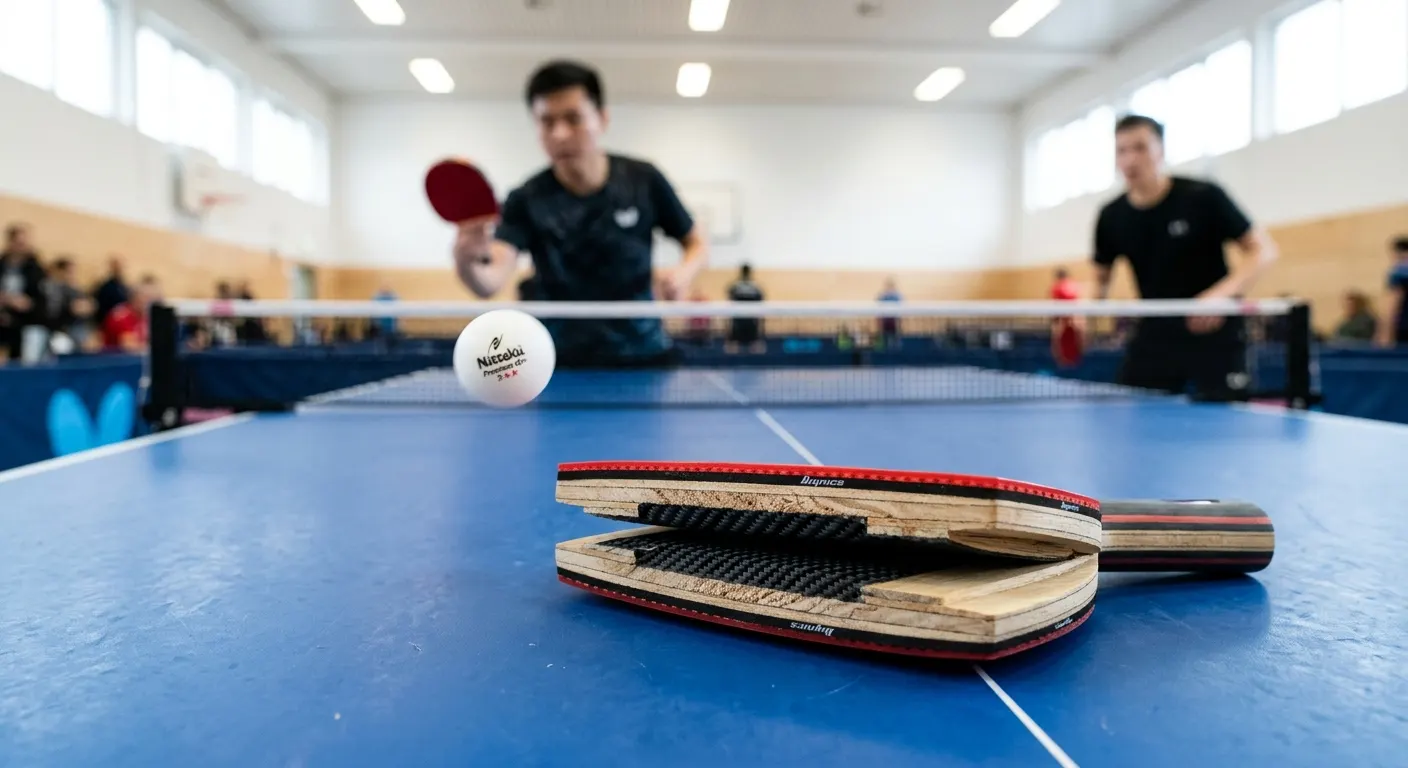
Every table tennis blade sits somewhere on a construction spectrum, and where any carbon layer sits inside that stack matters as much as whether carbon is present at all. A pure five-ply all-wood blade behaves nothing like a carbon-composite blade, and two carbon blades built to different specs, one with the reinforcing layer set inside the wood core and one with it set closer to the hitting surface, can feel like different equipment categories entirely. This guide breaks the blade market down by that construction axis rather than by brand name, walking through what an all-wood blade like the Stiga Infinity VPS V Blade or the Tibhar 5Q Blade actually gives you, what an inner-carbon blade like the Butterfly Timo Boll ALC Blade changes, and where a blade built for maximum surface stiffness like the Butterfly Zhang Jike Super ZLC Blade starts costing you more control than most players can spend.
Quick answer
All-wood blades like the Stiga Infinity VPS V give the longest dwell time and the most forgiving control for developing loop mechanics. Inner-carbon blades like the Butterfly Timo Boll ALC add speed while keeping meaningful touch. Outer-carbon blades like the Butterfly Zhang Jike Super ZLC maximize stiffness and pace at the cost of feel and margin for error.
This guide contains affiliate links. RallyRove may earn a commission at no cost to you.
What Actually Separates All-Wood, Inner Carbon, and Outer Carbon Blades?
The Stiga Infinity VPS V Blade is a five-ply all-wood blade with zero carbon content, and setting it side by side with a carbon-composite blade is the clearest way to see what carbon actually changes: blade stiffness, ball speed off contact, and how long the ball stays on the surface.
Blade construction is described in plies, the individual layers of wood, and in composite blades, non-wood material, pressed together to form the paddle face. A standard all-wood blade uses five or seven plies of different wood species, alternating grain direction for strength. Manufacturers publish the ply count and material stack for each blade model, and that published specification is the most reliable way to know what you are actually buying, since a blade named for a specific professional player does not by itself tell you the construction underneath.
Composite blades add one or more layers of carbon fiber, aramid fiber, or a fiber blend to that wood stack, and where manufacturers place that layer changes the blade's behavior more than the material itself. Butterfly's own blade specifications describe the Arylate-Carbon layer in blades like the Butterfly Timo Boll ALC Blade as an inner layer, set between wood plies rather than directly under the surface veneer, which is why the blade keeps noticeably more dwell time and touch than a blade with its fiber layer closer to the hitting surface. Blades that place the reinforcing layer nearer the outer face, sometimes marketed as surface-carbon or outer-carbon construction, transmit more of that fiber's stiffness directly into ball contact, which raises the speed ceiling but shortens dwell time and narrows the margin for a mistimed stroke.

Stiga Infinity VPS V Blade
A Swedish five-ply all-wood blade with a large sweet spot and a medium-fast speed rating that makes it one of the best blades for advancing intermediate players.

Butterfly Timo Boll ALC Blade
Named for the German world-class player and engineered around his style, the Timo Boll ALC pairs an Arylate-Carbon layer with a soft outer wood for speed with retained touch.
Which All-Wood Blade Should You Start With?
The Tibhar 5Q Blade is a five-ply all-wood blade with a large sweet spot and a controlled speed rating, and it is the more forgiving of the two pure-wood options in this comparison for a player still building consistent loop mechanics.
The DHS Power G13 Blade moves the construction to seven plies of wood instead of five, which stiffens the blade and shortens dwell time slightly, producing a heavier, more power-oriented feel that suits players who already generate pace through active, muscular strokes rather than players who are still learning to feel contact. Seven-ply construction is the traditional Chinese national-team approach to an all-wood attacking blade, and it pairs particularly well with tacky rubber, covered further below.
Between the two, the Stiga Infinity VPS V Blade sits in the middle: still five-ply and all-wood, but with a medium-fast speed rating and a sweet spot large enough to forgive off-center contact while a player's loop technique is still developing. None of these three blades contain any carbon at all, which is precisely the point. All-wood construction gives a player the longest dwell time available in the catalog, and dwell time is what lets a developing stroke actually feel what contact quality did to the ball, rather than having that feedback masked by a stiffer, faster material.

Tibhar 5Q Blade
A five-ply all-wood blade optimized for an all-round attacking style, with a controlled speed rating and a large sweet spot that suits developing intermediate players.
DHS Power G13 Blade
A seven-ply all-wood blade from the Chinese national team brand, offering a heavier, power-oriented feel for players who generate pace through active, muscular strokes.
Stiga Infinity VPS V Blade
A Swedish five-ply all-wood blade with a large sweet spot and a medium-fast speed rating that makes it one of the best blades for advancing intermediate players.
What Does the Inner-Carbon Layer in the Timo Boll ALC Actually Change?
The Butterfly Timo Boll ALC Blade pairs a soft outer wood veneer with an Arylate-Carbon layer set inside the ply stack, and that inner placement is the specific design choice that lets the blade add real carbon speed without stripping away the touch a player needs for short game and blocking.
Per Butterfly's blade construction description, the Arylate-Carbon (ALC) layer sits between wood plies rather than directly beneath the surface, so the ball still spends measurable time in contact with a wood surface before the carbon layer's stiffness adds pace to the shot. The practical result is a blade that feels faster than the Stiga Infinity VPS V Blade on a full loop but still gives enough feedback on touch shots and blocks that advanced players use it for close-to-table play, not just power hitting.
This is why inner-carbon blades occupy the middle tier of the construction spectrum: faster and stiffer than any all-wood blade like the Tibhar 5Q Blade or the DHS Power G13 Blade, but with more retained dwell time than a blade built for maximum surface stiffness. It is the right upgrade for a player whose loop mechanics are already consistent on a five-ply blade and who wants more pace without giving up the ability to feel a short push or a controlled block.
Butterfly Timo Boll ALC Blade
Named for the German world-class player and engineered around his style, the Timo Boll ALC pairs an Arylate-Carbon layer with a soft outer wood for speed with retained touch.
When Does Outer Carbon Turn Speed Into a Liability?
The Butterfly Zhang Jike Super ZLC Blade uses a Super ZLC (Zylon-Carbon) fiber layer built for maximum stiffness and speed, and it sits at the far end of the construction spectrum from the all-wood blades covered above, trading dwell time for raw pace.
Butterfly markets the Super ZLC construction toward elite, world-championship-level players, and that positioning reflects a real tradeoff rather than marketing language: a stiffer fiber layer set closer to the surface returns the ball faster on every contact, which means a player's timing window for a controlled shot shrinks correspondingly. A recreational or intermediate player who has not yet built the compact, precisely timed loop technique that elite players use will find balls flying long on shots that would have landed cleanly off a slower blade like the Stiga Infinity VPS V Blade or the Butterfly Timo Boll ALC Blade.
The blade is not overrated. It genuinely performs at the level its price suggests, but it performs for a narrow band of players whose technique can already control full-power carbon speed on every stroke. For everyone else, an inner-carbon blade or a five-ply all-wood blade will produce more usable improvement per dollar spent.
Butterfly Zhang Jike Super ZLC Blade
Super ZL Carbon construction used by former world champion Zhang Jike. An exceptionally fast blade for elite players who generate pace and spin from technique rather than force.
What Do ITTF Rules Say About How Much Carbon a Blade Can Contain?
Whether you choose the all-wood Stiga Infinity VPS V Blade or a carbon blade like the Butterfly Timo Boll ALC Blade, every legal blade has to satisfy the same construction limit: under ITTF equipment regulations, at least 85 percent of the blade's thickness must be natural wood, which caps how much carbon or other fiber material any blade, regardless of brand or price, can legally contain.
This is why even the fastest carbon blades in the catalog, including the Butterfly Zhang Jike Super ZLC Blade, are still built on a wood-dominant core rather than a pure carbon composite. The carbon or fiber layer adds stiffness and speed at the margins, but the wood majority is what keeps the ball legal for sanctioned play and what keeps every blade in this guide, from the Tibhar 5Q Blade to the priciest carbon option, recognizably a wood paddle rather than a fiber one.
For a shopper, the ITTF rule mostly matters as reassurance rather than a decision point: every blade sold by a major manufacturer for competitive use, all-wood or composite, is built to meet it, so legality is rarely the deciding factor between construction types. The deciding factor is almost always whether your current technique benefits more from wood's control or carbon's speed.
Stiga Infinity VPS V Blade
A Swedish five-ply all-wood blade with a large sweet spot and a medium-fast speed rating that makes it one of the best blades for advancing intermediate players.
Butterfly Timo Boll ALC Blade
Named for the German world-class player and engineered around his style, the Timo Boll ALC pairs an Arylate-Carbon layer with a soft outer wood for speed with retained touch.
Butterfly Zhang Jike Super ZLC Blade
Super ZL Carbon construction used by former world champion Zhang Jike. An exceptionally fast blade for elite players who generate pace and spin from technique rather than force.
Tibhar 5Q Blade
A five-ply all-wood blade optimized for an all-round attacking style, with a controlled speed rating and a large sweet spot that suits developing intermediate players.
All-Wood, Inner Carbon, and Outer Carbon at a Glance: Which Fits Your Game?
Lined up side by side, the Stiga Infinity VPS V Blade (all-wood), the Butterfly Timo Boll ALC Blade (inner carbon), and the Butterfly Zhang Jike Super ZLC Blade (outer carbon) show the full range of what blade construction alone changes before rubber ever enters the equation.
All-wood, five-ply construction: the longest dwell time, the most forgiving margin on off-center contact, and the lowest speed ceiling. Inner-carbon construction, like the Arylate-Carbon layer in the Timo Boll ALC: meaningfully faster than all-wood with most of the touch retained, because the fiber layer sits inside the ply stack rather than under the surface. Outer or surface-carbon construction, like the Super ZLC layer in the Zhang Jike blade: the highest speed and stiffness in the catalog, with the shortest dwell time and the least room for timing error.
The one-sentence version: start on wood, move to inner carbon once your loop is consistent, and save outer carbon for the point where your technique, not your equipment, is what is limiting your speed.
Stiga Infinity VPS V Blade
A Swedish five-ply all-wood blade with a large sweet spot and a medium-fast speed rating that makes it one of the best blades for advancing intermediate players.
Butterfly Timo Boll ALC Blade
Named for the German world-class player and engineered around his style, the Timo Boll ALC pairs an Arylate-Carbon layer with a soft outer wood for speed with retained touch.
Butterfly Zhang Jike Super ZLC Blade
Super ZL Carbon construction used by former world champion Zhang Jike. An exceptionally fast blade for elite players who generate pace and spin from technique rather than force.
How Should You Pair Rubber to Each Blade Construction?
The DHS Power G13 Blade is built to complement tacky rubber like the DHS Hurricane 3, and that pairing illustrates a rule that applies across every blade construction covered here: rubber speed and blade speed need to be matched, not simply maximized independently.
A slower all-wood blade like the Tibhar 5Q Blade or the Stiga Infinity VPS V Blade can absorb some of a faster rubber's pace, since the blade's own softness takes some speed back out of the combination, so pairing wood with a stronger rubber like the Butterfly Tenergy 05 is a reasonable way to add spin without moving to carbon yet. A carbon blade like the Butterfly Timo Boll ALC Blade already adds speed on its own, so stacking it with the fastest available rubber compounds the speed twice over and can produce a combination that only advanced players can control on every shot.
The practical sequence most players follow is to add speed through rubber first, since rubber is cheaper to replace and easier to size back down if it turns out too fast, and reserve a blade upgrade, whether to inner carbon or outer carbon, for the point where a good all-wood blade has become the limiting factor rather than the rubber sitting on it.
DHS Power G13 Blade
A seven-ply all-wood blade from the Chinese national team brand, offering a heavier, power-oriented feel for players who generate pace through active, muscular strokes.

DHS Hurricane 3
The dominant rubber of the Chinese national team and arguably the most influential table tennis rubber ever made. Tacky topsheet with a dense sponge generates heavy loop spin through controlled, deliberate mechanics.
Tibhar 5Q Blade
A five-ply all-wood blade optimized for an all-round attacking style, with a controlled speed rating and a large sweet spot that suits developing intermediate players.
Stiga Infinity VPS V Blade
A Swedish five-ply all-wood blade with a large sweet spot and a medium-fast speed rating that makes it one of the best blades for advancing intermediate players.
Butterfly Tenergy 05
The benchmark offensive rubber used at the highest levels of the game for two decades. Spring Sponge technology generates exceptional topspin and a stable arc on full-swing loops.
Butterfly Timo Boll ALC Blade
Named for the German world-class player and engineered around his style, the Timo Boll ALC pairs an Arylate-Carbon layer with a soft outer wood for speed with retained touch.
Featured in this guide
Stiga Infinity VPS V Blade
A Swedish five-ply all-wood blade with a large sweet spot and a medium-fast speed rating that makes it one of the best blades for advancing intermediate players.
Butterfly Timo Boll ALC Blade
Named for the German world-class player and engineered around his style, the Timo Boll ALC pairs an Arylate-Carbon layer with a soft outer wood for speed with retained touch.
Butterfly Zhang Jike Super ZLC Blade
Super ZL Carbon construction used by former world champion Zhang Jike. An exceptionally fast blade for elite players who generate pace and spin from technique rather than force.
DHS Power G13 Blade
A seven-ply all-wood blade from the Chinese national team brand, offering a heavier, power-oriented feel for players who generate pace through active, muscular strokes.
Tibhar 5Q Blade
A five-ply all-wood blade optimized for an all-round attacking style, with a controlled speed rating and a large sweet spot that suits developing intermediate players.
Butterfly Tenergy 05
The benchmark offensive rubber used at the highest levels of the game for two decades. Spring Sponge technology generates exceptional topspin and a stable arc on full-swing loops.
DHS Hurricane 3
The dominant rubber of the Chinese national team and arguably the most influential table tennis rubber ever made. Tacky topsheet with a dense sponge generates heavy loop spin through controlled, deliberate mechanics.
Related roundups
FAQ
Frequently asked questions
What is the difference between inner carbon and outer carbon in a table tennis blade?+
Inner-carbon blades place the reinforcing fiber layer between wood plies, closer to the blade's core, which is how Butterfly describes the Arylate-Carbon layer in the Timo Boll ALC. Outer-carbon or surface-carbon blades place that same type of layer closer to the hitting surface, directly under the outer veneer. The closer the fiber sits to contact, the more of its stiffness transfers directly into ball speed, and the less dwell time and touch the blade retains.
Is a carbon blade always faster than an all-wood blade?+
Almost always, yes, but the amount of speed added depends heavily on where the carbon sits. An inner-carbon blade like the Butterfly Timo Boll ALC adds a moderate speed increase over an all-wood blade like the Stiga Infinity VPS V while keeping meaningful dwell time. An outer-carbon blade like the Butterfly Zhang Jike Super ZLC adds considerably more speed and stiffness, with a correspondingly shorter dwell time and less margin for a mistimed stroke.
How much wood does ITTF require in a legal blade?+
Under ITTF equipment regulations, at least 85 percent of a table tennis blade's thickness must be natural wood. This applies to every legal blade sold for sanctioned play, all-wood or carbon-composite, and is why even the fastest carbon blades in the catalog are still built on a wood-dominant core rather than a pure fiber composite.
Should a beginner ever buy a carbon blade?+
Generally no. A beginner or player still developing consistent loop mechanics gets more value from an all-wood blade like the Stiga Infinity VPS V or the Tibhar 5Q, which offers longer dwell time and more forgiveness on off-center contact. Carbon blades, whether inner-carbon like the Timo Boll ALC or outer-carbon like the Zhang Jike Super ZLC, reward a player who can already produce consistent, well-timed strokes and punish a player who cannot.
Do seven-ply all-wood blades count as carbon blades?+
No. Ply count and carbon content are separate specifications. A seven-ply blade like the DHS Power G13 is still 100 percent wood, just with two more layers than a standard five-ply blade, which adds stiffness and a heavier, more power-oriented feel without introducing any carbon fiber. Carbon-composite blades are labeled separately from ply count and specify the fiber material and its placement in the construction.