Table Tennis Statistics 2026: 20+ Data Points on Market Size, Participation, and Speed
By RallyRove · 8 min read · Updated July 2026
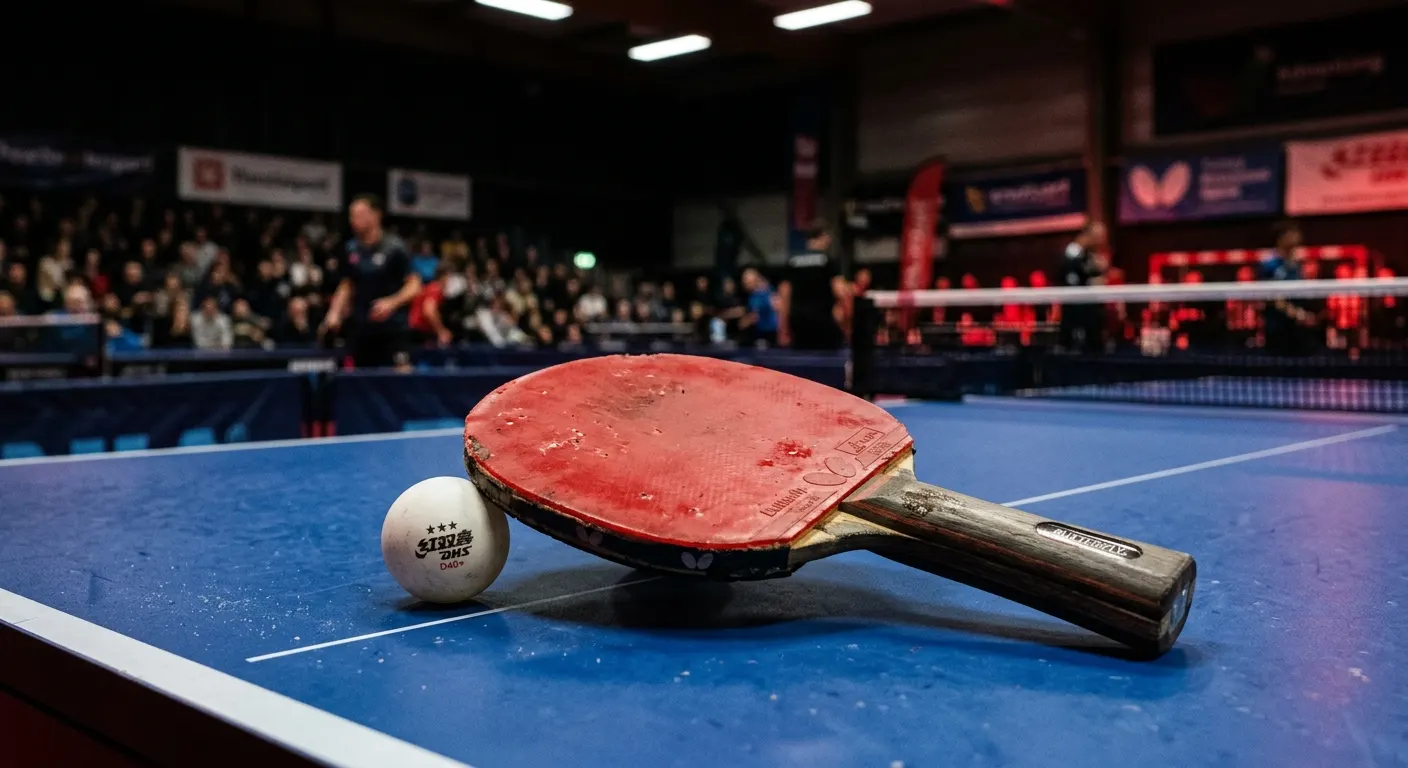
Table tennis is a sport with a strange split personality: enormous casual participation, a tiny competitive membership base, and one country that has won almost every Olympic gold on offer since the sport joined the Games. This page collects more than 20 fully sourced statistics for 2026: how large the equipment market is, how many people actually play, how dominant China has been at the Olympic level, and the real numbers behind the sport's reputation for speed and rubber that wears out fast. Every figure below names its source and year so you can cite it with confidence. The data draws on IMARC Group, Fortune Business Insights, USA Table Tennis, the ITTF, and other market and governing-body sources.
Quick answer
IMARC Group sizes the table tennis equipment market at 905.6 million dollars in 2025, while Fortune Business Insights puts the equipment category near 4.83 billion dollars. About 19 million Americans play recreationally against just 14,000 USA Table Tennis members, and China has won 37 of a possible 42 Olympic table tennis golds since 1988, sweeping all 5 at Paris 2024.
This guide contains affiliate links. RallyRove may earn a commission at no cost to you.
The size of the table tennis equipment market
Market-size estimates vary by scope, so the honest answer is a range. IMARC Group sizes the global table tennis equipment market at 905.6 million dollars in 2025, projecting 1,152.7 million by 2034 at a 2.64 percent CAGR. Fortune Business Insights uses a broader definition and puts the same category at 4.83 billion dollars in 2025, heading toward 7.85 billion by 2034 at a 5.38 percent CAGR. Verified Market Reports lands in between at 1.5 billion dollars for 2025.
Within the ball segment specifically, Research and Markets sizes the global table tennis ball market at 653.5 million dollars in 2025, growing to 828.32 million by 2031 at a 4 percent CAGR. Rackets and paddles represent the largest of the four product categories overall (racket, ball, table, and accessories), and Asia Pacific holds the largest regional share of the equipment market per IMARC Group.
How many people actually play
The gap between casual and competitive participation in table tennis is unusually wide. In the United States, about 19 million Americans play the sport recreationally, a figure that traces back to a 2010 Wall Street Journal report, while USA Table Tennis, the sport's national governing body, counts only about 14,000 registered members as of late 2024, spread across more than 250 affiliated clubs. USATT rolled out new Bronze, Silver, and Gold membership tiers effective January 1, 2026, gating access to club leagues, star-rated tournaments, and premier events like the U.S. Nationals by tier.
Globally, World Table Tennis estimates roughly 350 million players and fans worldwide, spread across 226 national member associations under the ITTF, though that figure blends active players with casual fans rather than counting registered competitors. In China, where the sport is a cultural fixture, an estimated 10 million people play regularly and as many as 300 million play on occasion.
China's Olympic dominance
No country has dominated a single Olympic sport quite like China has dominated table tennis. Since the sport joined the Summer Games in 1988, China has won 66 of the medals available across 42 events: 37 gold, 21 silver, and 8 bronze. At Paris 2024, China swept all 5 available gold medals, part of a run in which the country has missed the men's singles gold only once (Athens 2004) since 1996. Table tennis at Paris 2024 also drew a genuine crowd, with more than 230,000 spectators attending across 15 days of competition at South Paris Arena 4.
Speed, reaction time, and the plastic ball
Table tennis is not the fastest ball in sport (a badminton shuttlecock and a golf ball both travel faster), but it produces the shortest reaction window of any racket sport. Over the table's 2.74 meter length at a 70 mph shot, the ball reaches the opponent in roughly 0.14 seconds, and match-play analysis puts the average rally pace at about 2.00 hits per second, versus 1.72 for badminton. The fastest recorded competitive smash sits at a Guinness World Record of 72.08 mph, set by Lukasz Budner in 2016.
Equipment rules have changed the sport's physical character too. The ITTF made plastic ("poly") balls mandatory for all sanctioned and World Title events starting July 1, 2014, phasing out the flammable celluloid balls that had been standard for over a century; the last celluloid-approved supplier lost approval by the end of 2020.
Rubber: the sport's real consumable
The statistic that matters most to any serious player's budget is rubber life, not market size. Active club and league players should expect to replace rubber every 2 to 6 months depending on training volume and sheet type, while players in daily multi-ball training at a competitive level can burn through a sheet in as little as 3 weeks to 2 months. That consumable cycle, more than any single piece of hardware, is what drives repeat spending in the sport, whether the sheet in question is a tacky Chinese rubber like the DHS Hurricane 3 or a non-tacky European sheet like the Butterfly Tenergy 05.

DHS Hurricane 3
The dominant rubber of the Chinese national team and arguably the most influential table tennis rubber ever made. Tacky topsheet with a dense sponge generates heavy loop spin through controlled, deliberate mechanics.

Butterfly Tenergy 05
The benchmark offensive rubber used at the highest levels of the game for two decades. Spring Sponge technology generates exceptional topspin and a stable arc on full-swing loops.
Sources
IMARC Group, Fortune Business Insights, Verified Market Reports, and Research and Markets, table tennis equipment and ball market reports, 2025.
Wikipedia (USA Table Tennis), citing the Wall Street Journal, 2010, and USA Table Tennis membership data, 2024 to 2025.
World Table Tennis (WTT) and PingSunday, global participation and ITTF member association estimates, 2026.
Wikipedia, List of Olympic medalists in table tennis; International Table Tennis Federation (ITTF), Paris 2024 results and attendance reporting, 2024.
PingSunday and TT Crunch, table tennis speed and reaction-time analysis, 2026.
International Table Tennis Federation (ITTF), celluloid-to-plastic ball transition history, 2020.
Racket Insight and JOOLA USA (MHTT Blog), rubber replacement cycle guidance, 2026.
Keep reading
Related comparisons
Related roundups
FAQ
Frequently asked questions
How big is the table tennis equipment market?+
Estimates vary by scope. IMARC Group sizes the global table tennis equipment market at about 905.6 million dollars for 2025, while Fortune Business Insights, using a broader definition, puts the same category near 4.83 billion dollars. Rackets and paddles make up the largest product segment, and Asia Pacific is the largest region.
How many people play table tennis in the US?+
About 19 million Americans play table tennis recreationally, a figure that traces to a 2010 Wall Street Journal report. USA Table Tennis, the sport's governing body, counts only about 14,000 registered members as of late 2024 across more than 250 affiliated clubs, a small fraction of total recreational players.
How dominant is China in Olympic table tennis?+
Extremely. China has won 66 of the medals available across 42 Olympic table tennis events since 1988, including 37 of a possible 42 golds, and swept all 5 gold medals at Paris 2024. China has missed the men's singles gold only once since 1996.
How fast is a table tennis ball?+
The fastest recorded competitive smash is a Guinness World Record of 72.08 mph, set in 2016. Table tennis is not the fastest ball in sport, but it produces the shortest reaction time of any racket sport, roughly 0.14 seconds for the ball to cross the table at competitive speed.
How often should competitive players replace their rubber?+
Active club and league players typically replace rubber every 2 to 6 months depending on training volume and sheet type. Players training daily at a high competitive level can wear out a sheet in as little as 3 weeks to 2 months. Performance signs (lost tack, reduced spin, balls flying long) matter more than a fixed calendar.
When did table tennis switch from celluloid to plastic balls?+
The ITTF made plastic balls mandatory for all sanctioned and World Title events starting July 1, 2014. The transition phased out celluloid, a flammable material with restrictive shipping rules, over several years; the last celluloid-approved supplier lost approval by the end of 2020.